

Meet Our Graduate Fellows
The Graduate Fellows program is intended for students who want to complement their engagement in global affairs within a vibrant community of scholars, students, and visitors, while also developing professional skills relevant to shaping policy.
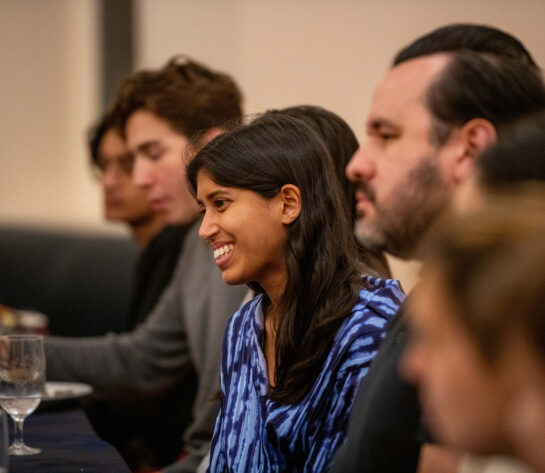
2025-26 Graduate Fellows
Angela Bongiovanni is a Ph.D. Candidate in the Perelman School of Medicine’s Neuroscience Graduate Group. Her research leverages a novel immunocompetent human brain organoid platform to model HIV infection in the central nervous system. Angela has a dedicated interest in foreign affairs and is particularly focused on research security and emergent biotechnology policy. Angela is an active member of the Penn Science Policy and Diplomacy Group where she will be leading a research security initiative this coming academic year. She holds a BA in psychology and a BS in neuroscience from Temple University.
Dimitris Boufidis is a Bioengineering Ph.D. student at the University of Pennsylvania, where he develops biohybrid and “living” neural interfaces to treat neurological diseases. As the Science Diplomacy Chair of the Penn Science Policy and Diplomacy Group (PSPDG), Dimitris leads the group’s educational programming and science diplomacy curriculum. He designs workshops, seminars, and training sessions that equip STEM Ph.D. students to connect their research with international policy-making and diplomacy. He also builds partnerships with embassies, diplomats, and scientific advisors to strengthen global collaboration. Originally from Greece, Dimitris graduated top of his class from the University of Sheffield (UK), where he received the 2022 Chancellor’s Medal. A TEDx speaker and committed STEM advocate, his outreach work has been featured by The Guardian and BBC News.
Abhi Chadha is a second-year at the Lauder Institute, where he is pursuing an MBA at The Wharton School and an MA in International Studies at the School of Arts & Sciences. His research interests focus on South Asia, having completed work on regional security, the India-Middle East-Europe Economic Corridor, and the media landscape. He is currently working to understand historical industrial policy in India in key segments of the economy. Prior to his time at Penn, Abhi was a senior consultant at Ernst & Young LLP, where he served banking and fintech clients on CFO priorities, corporate governance, IPO readiness, and risk strategy. On campus, Abhi is engaged with the Wharton Dean’s MBA Advisory Council, Follies (an annual musical), and Pub. In his free time, he enjoys running along the Schuylkill River, reading a long-form journalism piece, and exploring Philadelphia. Abhi graduated from William & Mary with a BBA in Finance & Government.
Brannen Dickson is a dual-degree student in the MBA program at Wharton and the Lauder Institute, where he focuses on Mandarin language and East/Southeast Asia Studies. Prior to Wharton, Brannen worked at Pfizer, in their US Policy & Government Relations function. In this role, he touched issues ranging from vaccines to industry engagement at COP28. Upon graduating from Wharton, Brannen will return to Pfizer. An avid follower of geopolitics and all things international relations, Brannen speaks Spanish, Mandarin Chinese, and is conversational in Russian. He obtained his Bachelor’s degree in Public Policy Studies & Spanish from Vanderbilt University.
Luca Garzino Demo is a PhD student in philosophy of science at the University of Pennsylvania. Originally from Italy, Luca developed his background in philosophy and sociology, and explores the fascinating dynamics of trust, norms, and information flow in scientific communities in his research. When not immersed in academic pursuits, you’ll find Luca capturing the world through his camera lens.
Max Gebauer is a fourth-year Ph.D. candidate in philosophy at the University of Pennsylvania and an M.A. student in Statistics & Data Science at the Wharton School. His philosophy of science research examines Bayesian methods and the role of non-epistemic values in scientific practice. In statistics, he works on epidemiological modeling and sports analytics. He has previously worked with the Wharton Sports Analytics and Business Initiative and the Center for Ethics and the Rule of Law. He earned a B.A. in Philosophy from Washington and Lee University in 2022.
Anastasia Gracheva is a 4th year PhD student in the Strategy and Multinational Management subfields at Wharton. Her current research involves various topics in non-market strategy, including how firms interact with social and political environments and what the consequences are for performance, resilience, people, and organizational design. At Wharton, she has been named a 2025 CETLI Graduate Fellow and is involved in mentorship and community-based groups in her department and beyond. She received her M.A. in Management Science and Applied Economics from Wharton, and her B.A. degrees from Columbia University and SciencesPo Paris, with the highest honors.
Natalia Henry is a PhD student in the Department of Political Science, focusing on the subfields of International Relations and Comparative Politics. Her research interests include military technology, innovation, and effectiveness, with particular attention to non-state actors in conflict. Prior to attending UPenn, Natalia worked at the Boston Consulting Group (BCG). She received her B.A. from Dartmouth College in 2021, with a major in History and a minor in Government.
Nathen Huang is a graduate student in the joint-degree MBA/MA in International Studies (Europe—German) program between the Wharton School and the Lauder Institute at the University of Pennsylvania. Nathen’s research interests center on questions of technology, democracy, and corporate diplomacy- namely best practices and regulatory models that balance innovation with societal protection. He seeks to understand how emerging technologies engender both technological optimism and nihilism that influence societal notions of “responsible” technology. With this research, Nathen aims to shape platform governance, champion digital rights, and counter extremism throughout his career. Previously, Nathen was Chief of Staff and Senior Advisor to the second U.S. Special Envoy to Advance the Human Rights of Lesbian, Gay, Bisexual, Transgender, Queer and Intersex Persons and a Presidential Innovation Fellow at the State Department. He holds a Master’s degree in Quantitative Methods in the Social Sciences and a Bachelor’s in Psychology from Columbia University.
Keshav Katti is a 4th-year PhD student in Electrical & Systems Engineering (ESE) at the Penn School of Engineering & Applied Science, where he conducts research in neuromorphic computing, a field residing at the intersection of machine learning, computing hardware, and neuroscience. His work is funded by the National Science Foundation (NSF) Graduate Research Fellowship Program (GRFP). He serves as the President of the ESE PhD Association and is the Co-Founder of DJ@Penn, an organization dedicated to teaching and building community among on-campus DJs. Outside of Penn, Keshav is a Venture Partner at the Abelian Group, where he is responsible for sourcing and diligence of startup companies in artificial intelligence and robotics for investors.
Lauren Elizabeth Lee is a Ph.D. candidate in Cellular & Molecular Biology with a Cell biology, Physiology, and Metabolism concentration at the Perelman School of Medicine. Her research explores dysregulated metabolism as a driver of chronic diseases, leveraging computational bioinformatics of human patient samples and animal models of heart and kidney disease. She is also a Certificate of Law student at Penn Carey Law, where her legal research focuses on discrepancies of noncitizen healthcare access in high-income countries. Her policy engagement includes serving on the American Society of Nephrology Policy & Advocacy committee and hosting science policy workshops for the Penn Science Policy and Diplomacy Group. She also serves on the organizing committee for DEEPennSTEM, which equips under-resourced undergraduates prepare for STEM graduate studies at Penn. Outside of Penn, she volunteers with Skype a Scientist, a nonprofit connecting researchers with K-12 classrooms to promote direct engagement and conversation with scientists. Prior to her time at Penn, she worked as a research assistant in a kidney inflammation lab at UTSouthwestern Medical Center and a primary care medical assistant/scribe in Dallas, TX. She holds undergraduate degrees in Sports Medicine and Cello Performance.
Yash Mahajan is a fifth-year at the University of Pennsylvania who just completed his B.A. in Economics and submatriculated into the Master of Behavioral and Decision Sciences program, focusing on behavioural economics and artificial intelligence. Originally from Singapore, India, and the UK, his research interests lie in alternative financing pathways to invigorate socio-economic development in the Global South. As an LGBTQ+ rights activist, Yash’s work focuses on intersectionality and building infrastructure to uplift marginalised communities across dimensions. At Penn, he is a World Impact Davis Scholar, a research assistant at the Behaviour Change for Good Initiative studying behavioural incentives to improve decision-making, and a Wharton ESG Integration Fellow, working on sustainable capital allocation and energy transition strategy. Previously, Yash served on the cabinet for Penn’s Undergraduate Assembly, was president of the Interfraternity Council, and Chief of Staff for Penn’s competitive Model UN team, placing first at Harvard’s Model UN Conference.
Georgia Mies is a PhD candidate in the Genomics and Computational Biology graduate program at the Perelman School of Medicine. Her research integrates genetics, evolution, and global health, using computational methods to analyze large-scale genomic datasets from modern biobanks and ancient DNA to understand how populations have adapted over time and how these adaptations impact present-day health. Georgia serves as an e-board member of the Penn Science Policy and Diplomacy Group, organizing panels and dialogues with policymakers and science communicators on issues such as environmental justice and health equity. She also leads a local advocacy initiative promoting the importance of public transportation for public health. She graduated with Highest Honors from the University of Michigan with degrees in Ecology & Evolutionary Biology and Evolutionary Anthropology.
Shu Yi Neoh is a Master of Environmental Studies candidate specializing in climate strategy development and execution, climate risk management, and critical-minerals geopolitics. With over five years of experience in the energy industry, she previously worked at a national oil and gas company, where she co-authored its Net Zero roadmap and managed multi-stakeholder decarbonization initiatives, including Scope 1, 2, and 3 GHG accounting as well as TCFD-aligned risk disclosures. Her current capstone research explores sustainable energy optimization strategies to support the Artificial Intelligence era, with a focus on how digital infrastructure growth intersects with energy system resilience and the clean-energy transition.
Lindsay Park is pursuing an MS in Integrated Product Design (2026) at Penn’s School of Engineering, after completing a BSE in Systems Engineering (2025). As an undergraduate fellow at Perry World House, she researched the gender digital divide with the International Telecommunication Union and extreme heat solutions with UN-Habitat, sparking her interest in climate policy and the environmental impact of technological growth. She is currently conducting research in energy policy with Professor Shelley Welton at Penn Carey Law and supporting the Galápagos Education Research Alliance on a tree inventory initiative in San Cristóbal under Professors Michael Weisberg and Andrea Restrepo-Mieth. She hopes to apply her work toward advancing sustainable innovation in rapidly urbanizing cities.
Shrey Patel is a PhD candidate in the Department of Chemical and Biomolecular Engineering at the University of Pennsylvania. His research focuses on developing carbon management pathways to achieve net-zero targets, including advancing strategies to produce sustainable aviation fuels and make them cost-competitive with conventional jet fuel through chemical engineering, strategy, and policy. He also works with the Global Change Analysis Model (GCAM) to evaluate global deployment scenarios for carbon dioxide removal technologies. Originally from Ahmedabad, India, Shrey holds a B.Tech. (Hons) in Chemical Engineering from the Indian Institute of Technology Madras, with prior research experiences in India, Germany, and Canada. At Penn, he serves as President of the Graduate Student Hiking Club and is active in supporting international student initiatives.
Devo Probol is a Presidential PhD Fellow and Joint PhD Candidate in the Annenberg School for Communication and the Department of Sociology at the University of Pennsylvania. Her research spans social movement theory, digital cultures, economic sociology, and performance theory. She investigates the mobilization logics that shape digital activism and reconsiders how the successes and failures of social movements are conceptualized in the digital age. Her work also examines how collective identity formation influences both the emergence and endurance of online-originating social movements. Devo holds M.A. degrees in Communication and Sociology from the University of Pennsylvania, an M.S. in Strategic Communication from Columbia University, and a B.A. in History and Theology from Arizona State University.
Sean Pyles is a second-year MBA candidate at the Wharton School of the University of Pennsylvania, where he majors in Finance and Business Economics & Public Policy. His interests focus on how economic and financial institutions can be leveraged to strengthen national security. Sean has served nearly a decade in special operations on both active duty and in the reserves, with multiple deployments to the Middle East and Central Asia supporting counterterrorism and regional stabilization efforts. He has also worked in the U.S. Senate, where he contributed to national security, foreign policy, and veterans affairs initiatives. Sean holds a B.A. in Economics from Clemson University.
Charlotte Scott is a second year student pursuing a PhD in Sociology, where she studies environmental infrastructure implementation. She is currently at work on a project comparing proposed wind farm projects in California and Texas to study different state policy landscapes. Previously she worked in qualitative research at think tank and polling firm Data for Progress. She holds a Bachelor’s degree in Public Policy from the University of Chicago.
S. Colby Woods is a PhD student at the University of Pennsylvania’s Graduate School of Education. His research focuses on K–12 education policy, with work spanning topics on student absenteeism, school discipline, CTE course-taking, and teacher satisfaction. Many of his projects involve partnerships with local and state education agencies, including during his time with the Tennessee Education Research Alliance. He earned a Bachelor of Arts in International Studies and German from the University of Mississippi and a Master of Public Policy in Education from Vanderbilt University.
Hyun Yang is an MBA student at the Wharton School of the University of Pennsylvania whose research focuses on the intersection of infrastructure investment, national economic security, and public policy. He is interested in how private capital can be mobilized to address strategic infrastructure needs in Asia and globally. Prior to Wharton, Hyun worked in investment banking at Goldman Sachs and in the Infrastructure Private Equity group at Blackstone in New York and London. He holds a B.S. in Mathematics and Economics from the Massachusetts Institute of Technology and has led community engagement initiatives through the Wharton Korea Club.