Faculty Fellowship Projects
Our Faculty Fellows program deepens collaboration between faculty members across Penn’s 12 schools and Perry World House (PWH) by providing robust support for global-policy relevant faculty research and engagement.
About the Fellowship Projects
The Faculty Fellowship Projects invite Penn faculty to propose a project that brings their research to bear on global policy. We partner with faculty who have ongoing research with potential global policy impact, with a preference for one of PWH’s core areas, and who will work with us on a concrete vision for how to translate that research into policy action.
Faculty Fellowship Projects are not grants. They are a two-year collaboration through with PWH puts its resources, convening power, and practitioner network in service of the project. PWH provides the policy infrastructure to help faculty reach the relevant audiences and decision-makers who can act on it.
What Faculty Fellowship Projects Support
Over a two-year period, PWH funds and provides resources for one or more faculty leads of a project to lead on, at a minimum:
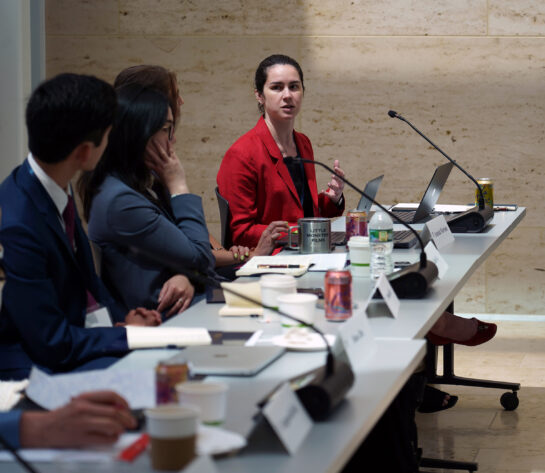
- One policy-relevant workshop. Workshops provide faculty with the opportunity to engage in substantive discussions with a diverse range of policymakers, practitioners, and scholars across varied institutional, national, and academic contexts.
- One policy-relevant public event. Public events bring together up to four experts and a moderator for a one-hour hybrid discussion on the PWH stage.
- Two non-resident visiting fellows, as part of the PWH Visiting Fellowship Program, over the two year term. The PWH Visiting Fellowship brings leading experts to Penn for up to nine days of structured on-campus engagement.
- Author one white paper published on the PWH website. White papers offer faculty a rigorous platform to present original research, analysis, and policy recommendations to expert and practitioner audiences.
- Other project-related activities and outputs, as agreed upon, over the two-year term.
How to Apply
Faculty Fellowship Projects use a two-stage application process to reduce burden on applicants. PWH aims to select 2 to 3 projects in this cycle.
Application Instructions
FFPs use a two-stage application process to reduce burden on applicants. PWH aims to select 2–3 projects int his cycle.
Application Timeline
| Stage | Date |
| Call for concept notes opens | May 26, 2026 |
| Concept note deadline | June 16, 2026 |
| Invitations to full proposal | June 30, 2026 or before if possible |
| Full proposal deadline | July 31, 2026 |
| Selection decisions communicated | August 28, 2026 |
| Planning period | September–December 2026 |
| Projects launch | January 2027 |
Stage 1: Concept Note Due: June 16, 2026
Applicants submit a concept note of 1-2 pages (1,500 words maximum). Concept notes should address:
1. The proposed research topic and its global policy relevance
2. The core vision for impact – the policy community/stakeholders you are trying to reach and how
3. Any early thinking on workshops, public events, and outputs (written, convening, media)
4. Any early thinking on potential visiting fellows from the policy world that could be associated with the project
5. Any early thinking on interdisciplinarity and student engagement opportunities
Concept notes should be submitted via https://apply.interfolio.com/187160. There is no required format, but applicants are encouraged to write for a generalist audience.
Applicants continuing to the next round of consideration will be notified on or before June 30, 2026, and asked to submit a full proposal. Those not immediately selected to submit a full proposal will remain in the pipeline until further notice. Those asked to submit a full proposal will be offered the opportunity to meet with PWH leadership to discuss the project concept and opportunities for improvement of the full proposal.
Stage 2: Full Proposal Due: July 31, 2026
Full proposals must address all elements listed in the Criteria (section above) and include:
• Project narrative (2,500-3,000 words maximum, excluding bibliography). In addition to discussing the elements in the criteria sections, the narrative should include insight regarding:
◦ A project workshop
◦ A public event
◦ Ideas for at least 2 potential Visiting Fellows that could be associated with the project
◦ A white paper and other outputs
• Biographical sketch(es) for the PI and any co-PIs (250 words each)
• A timeline of proposed activities with narrative justification
• A timeline of written outputs inclusive of a white paper of 25-50 pages in length, along with any other written products you may wish to produce, publish, or use to advance your policy impact
• Written support from Department Chair and/or Dean
Proposals should be submitted via https://apply.interfolio.com/187160.